
Exploring the History of Artificial Intelligence
Artificial Intelligence (AI) has reshaped the digital age, but its origins date back further than many realize. This article explores when artificial intelligence was invented, tracing the evolution of AI from early computer science concepts to modern machine learning, deep learning, and generative artificial intelligence—highlighting key figures, milestones, and its growing impact on business, technology, and society.
Summer, 1956. A handful of mathematicians arrive at Dartmouth College with a proposal that every aspect of learning can, in principle, be described so precisely that a machine can be made to simulate it.
They thought it would take a summer. It took seventy years, two winters, and a few billion GPUs.
To understand why your phone can now book an appointment, it helps to know where the idea came from.
Artificial Intelligence (AI) has profoundly transformed the landscape of technology and society, ushering in the digital age. However, its origins are often overlooked. This article explores the history of artificial intelligence, tracing its roots from early concepts in computer science to modern advancements in AI technology. Readers will gain insight into key figures, major milestones, and the ongoing ai evolution that has shaped the field.
Understanding when artificial intelligence was invented—and how it developed over time—provides essential context for its current applications of artificial intelligence and its immense future potential. As we examine the AI timeline, we will address early challenges, significant breakthroughs, and the continued evolution of this dynamic field, including its philosophical foundations, ethics, and inherent risk. This article also explores AI’s growing influence on business, productivity, and innovation in the modern world.
Who Coined the Term Artificial Intelligence and When?
The term Artificial Intelligence was coined in the mid-20th century, marking a pivotal moment in the history of computer science. This section highlights the foundational contributions of John McCarthy and examines the significance of the Dartmouth Conference of 1956, widely regarded as the birthplace of formal AI research.
John McCarthy’s Role in Defining AI in 1956
John McCarthy, a pioneering computer scientist and programmer, formally introduced the term artificial intelligence in 1956. He proposed it in a research proposal for the Dartmouth Conference, where he and fellow researchers sought to explore how machines could simulate aspects of human intelligence through computer programs.
McCarthy envisioned AI systems capable of thinking, learning, and problem solving using logic and formal reasoning. His work laid the intellectual foundation for much of modern AI, influencing fields such as symbolic reasoning, software development, and automated decision-making. Many of today’s core AI concepts can be traced directly to his early theoretical contributions.
The Significance of the Dartmouth Conference in 1956
The Dartmouth Conference of 1956 is widely recognized as the formal starting point of AI as an academic discipline. The event brought together leading thinkers such as Marvin Minsky and Claude Shannon to discuss machine intelligence, cognition, and computational approaches to human-like reasoning.
The conference aimed to explore how machines could learn from experience, use language, and solve problems autonomously. These discussions established the intellectual foundation for modern AI technology and set a long-term research agenda that continues to influence AI development today. The Dartmouth Conference also fostered interdisciplinary collaboration, accelerating innovation in computer science and related fields.
What Were the Early Developments in AI Before and After 1956?
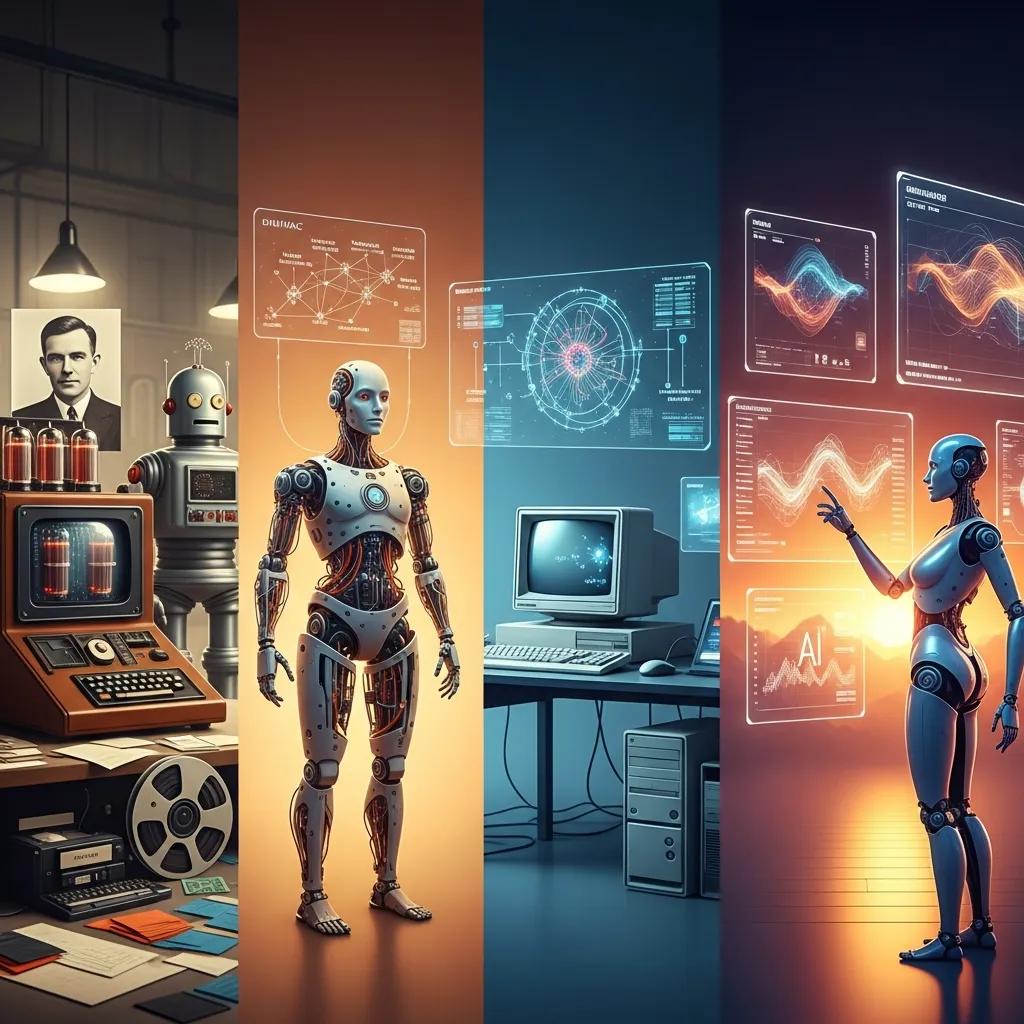
Following the Dartmouth Conference, AI research advanced rapidly. Foundational work by figures such as Alan Turing and the creation of early AI programs marked important milestones in software engineering and computational intelligence.
Alan Turing’s Foundational Contributions and the Turing Test
Alan Turing, a renowned mathematician and logician, made critical early contributions to AI theory. In his 1950 paper Computing Machinery and Intelligence, he proposed what later became known as the Turing Test, a framework for evaluating a machine’s ability to demonstrate intelligent behavior indistinguishable from that of a human.
Turing’s work introduced enduring questions about machine intelligence, human intelligence, and the nature of the mind. His ideas remain central to ongoing discussions surrounding AI ethics, consciousness, and the limits of artificial cognition.
Pioneering AI Programs: Logic Theorist and ELIZA
Several early AI programs demonstrated the feasibility of intelligent machines. The Logic Theorist, developed by Allen Newell and Herbert A. Simon in 1956, was among the first programs capable of problem solving, successfully proving mathematical theorems.
In the mid-1960s, Joseph Weizenbaum developed ELIZA, an early chatbot that simulated conversation using natural language processing. Although simple by modern standards, ELIZA revealed how machines could engage in human-like dialogue, foreshadowing later advancements in conversational AI and applications of artificial intelligence.
What Challenges Did AI Face in Its Early Years?
Despite early optimism, AI development faced substantial obstacles. These challenges led to periods known as AI winters, characterized by reduced funding, diminished public interest, and growing skepticism.
Understanding the AI Winters: Causes and Impact
AI winters occurred when ambitious expectations outpaced technological reality. Early AI systems struggled with limited computer hardware, insufficient data, and underdeveloped algorithms. As a result, promised breakthroughs failed to materialize, leading to declines in funding and institutional support.
The first major AI winter emerged in the mid-1970s and had long-lasting effects on AI research. However, these setbacks also prompted more realistic approaches, ultimately strengthening the field’s theoretical and practical foundations.
From Early Enthusiasm to Funding Reductions
As limitations in early AI systems became evident, enthusiasm gave way to caution. Governments and private investors reduced support, slowing research activity and innovation. While progress stalled, the foundational work completed during this period later enabled the resurgence of AI, contributing directly to the modern ai boom.
How Has AI Evolved from Its Inception to Modern Times?
The modern ai evolution has been shaped by advances in machine learning, deep learning, and generative artificial intelligence. Improvements in computational power, data availability, and cloud computing have accelerated AI development across industries.
The Rise of Machine Learning and Deep Learning
Machine learning emerged as a dominant AI approach in the late 20th century, allowing machines to learn from data without explicit programming. Key techniques such as neural networks, support vector machines, and backpropagation laid the groundwork for modern AI systems.
Deep learning, powered by advanced neural networks and graphics processing units (GPUs), enabled breakthroughs in image recognition, speech recognition, and computer vision. Contributions from researchers like Geoffrey Hinton, along with large datasets such as ImageNet, triggered a major AI renaissance.
Notable milestones include IBM’s Deep Blue defeating chess champion Garry Kasparov and Google DeepMind’s AlphaGo mastering the game of Go—both landmark demonstrations of advanced problem solving and learning.
The Emergence of Generative AI: ChatGPT and Beyond
Recent years have seen the rise of generative artificial intelligence, including ChatGPT and other large language models. Built on advanced architectures such as the transformer, these systems can generate human-like text, support content creation, and power virtual assistant technologies like Siri.
Generative AI has also transformed digital art and artificial intelligence art through tools such as Stable Diffusion, Midjourney AI, and Imagen. These diffusion model technologies enable sophisticated image editing, photorealistic rendering, and creative expression across visual arts.
At the same time, generative AI raises important concerns related to ethics of artificial intelligence, bias, transparency, governance, and long-term risk, making responsible AI development increasingly critical.
AI in the Digital Age: Benefits and Future Potential
The continued ai evolution has delivered transformative benefits across nearly every sector. From enhanced productivity to advanced data analysis, artificial intelligence has become an indispensable tool in the digital age.
Key Benefits of AI Today:

Enhanced Productivity and Automation
AI-driven automation improves efficiency in industries such as manufacturing, retail, and logistics.Improved Customer Experience
Chatbot and virtual assistant technologies provide scalable, real-time customer service.Advanced Data Analysis and Prediction
Machine learning supports predictive analytics in finance, healthcare, marketing, and energy management.Innovation in Content Creation and Design
Generative artificial intelligence empowers creators through AI-driven digital art, image editing, and design tools.Scientific Research and Development
AI accelerates discovery in science and mathematics, including breakthroughs such as AlphaFold in protein folding.
Conclusion
From its formal inception in 1956 to today’s advanced AI systems, artificial intelligence has undergone continuous transformation. As AI advances toward greater autonomy, memory, and perception, understanding its historical context, philosophy, ethics, and associated risk is essential.
Organizations such as the Association for the Advancement of Artificial Intelligence (AAAI) and thought leaders like Peter Norvig continue to guide responsible AI innovation. As research progresses, AI’s influence on society, business, and human-machine interaction will only deepen—making its history as important as its future.
Future-Proof Your Business with LeadStreamAi.com
In today’s fast-moving AI-driven market, companies that fail to adapt risk falling behind. LeadStreamAi.com, led by CEO and Founder Eli Rivera, empowers businesses to stay ahead by combining real-time lead generation, predictive analytics, and automated engagement. With AI shaping how customers discover, evaluate, and buy products, having a system that not only keeps pace—but anticipates trends—is essential.
Here’s how LeadStreamAi.com positions your business for the future:
Predictive Lead Targeting: AI identifies high-value leads before your competitors even know they exist.
Seamless Multi-Channel Engagement: From email and SMS to calls and social outreach, AI ensures your message reaches the right audience at the right time.
Data-Driven Insights: Analytics dashboards reveal which strategies are converting and where opportunities lie, letting you pivot quickly.
Scalable Automation: As your business grows, AI handles repetitive tasks, freeing your team to focus on high-impact work.
By leveraging LeadStreamAi.com under the guidance of Eli Rivera, businesses don’t just react to AI trends—they thrive in them. Staying future-proof isn’t about guessing what’s next; it’s about having the intelligence, tools, and automation to act confidently today.
https://leadstreamai.com/